

What it does
Deliberately narrow, for now. BigCommerce and Royal Mail done properly, rather than a dozen of each done adequately. Shopify is next and is being built now. More platforms and more carriers will follow, in the order the people using it need them.
The queue
- One screen for everything waiting
- Orders awaiting fulfilment, with contents, weights, thumbnails and the delivery service the customer paid for, on the card rather than a click away.
- Filter and sort the way you pack
- By shop, by delivery service, by newest, by send-by date, by order number, by SKU. Search by order number, name, postcode, SKU or product.
- Send-by dates from your own promise
- Tell it what you promised at checkout and it works out the working day each order has to leave by, bank holidays included, and flags what is late.
- Made to order work flagged
- Personalisation, engraving, printed names, alterations, anything you can define by the option the customer chose at checkout. The lead time replaces the send-by date so nobody treats it as ordinary stock.
Splitting an order
- The parcel is the unit, not the order
- Shipping an order as one box and as three boxes are the same path with a different count. Nothing about splitting is a special case, which is the whole reason this exists.
- Exact line level shipments
- What goes back to BigCommerce holds the specific order product ids and quantities in that box, so a part shipped order stays correctly part shipped.
- Two benches cannot double ship
- The lines being packed are locked while the parcel is being made. The second bench is told, rather than quietly buying a second label.
- Short shipping is a first class action
- Mark what is missing, send what you have, and the rest of the order stays open and comes back on the queue when the stock lands.
Three ways to send it
- Print now
- The packing slip and the Royal Mail label together, and the BigCommerce shipment written straight away. What most orders need on most days.
- Check stock first
- For the order you think is in the shop but might not be. The label prints as normal, but the shipment and the customer's tracking email are held until somebody scans the barcode on the slip at the bench. If the item is not there after all, nothing has been promised to anybody.
- Slip only, label when you scan
- Nothing at all is bought at Royal Mail until the slip is scanned. The picker walks the shop with the paper, and the label prints at the bench they scan it at, for that day's despatch. The order leaves the queue while the slip is out, so a second bench cannot pack it as well.
- Per order, or for the whole batch
- You are not committing the shop to one way of working. Any of the three can be chosen on a single order or applied to a batch of fifty.
- Future dated batches
- Print today for a despatch day you choose. The tracking reaches BigCommerce, and therefore your customer, at half past six on the morning it actually goes, rather than the day you printed it.
Royal Mail
- Your own account, your own rates
- Labels are bought through your Royal Mail account. Nothing is resold to you and no margin is taken on postage.
- Two accounts, two shops
- Route by product, by brand, by category or by whatever rule fits your business. A mixed order can be split across both accounts, one parcel each.
- Service and format worked out
- Tracked 24, Tracked 48 and the untracked 24 and 48 services, with Large Letter or Parcel decided from the weight and dimensions you hold against each SKU.
- Your end of day stays where it is
- Manifesting carries on in Click and Drop exactly as it does now. DispatchThread does not try to own your carrier relationship.
Printing
- Each bench prints to its own printer
- A small agent runs on each packing PC and claims only that bench's jobs. Nothing is shared, and nothing comes out in the wrong room.
- True six by four
- Rendered at 203 dpi for thermal printers, so the label prints at one hundred per cent with no scaling and no shrunken barcode.
- Slips stack the right way up
- Sheets print in reverse order so the pile comes off the printer as label, sheet one, sheet two, ready to pack without sorting.
- Reprint without paying twice
- Labels are kept so a jam, a misfeed or a lost sheet costs you paper and nothing else. One button reprints the slip and the label together.
People
- One account per person
- Not one shared login taped to the monitor. Each account belongs to a shop, and the shop decides which orders they see and which printers they can send to.
- A bench can be pinned
- Open the app with the station in the address and that machine always knows which bench it is, so nobody picks the wrong printer on a Monday morning.
Your rules, and you can change them
- The things that decide money are settings, not code
- How your checkout delivery options map to Royal Mail services. Which products are made to order and what lead time they carry. Which of your shops fulfils what. Which services sit on which account, and whether a parcel's format is decided by weight. All of it edited in the app, by you, without waiting for anybody.
- A preview before you can save it
- Anything that decides which account is charged, or whether an order can be labelled at all, shows you what it would actually do first. Which orders waiting right now would move to a different Royal Mail account. Which could no longer be labelled. You are approving the consequence rather than the wording.
- Every version kept
- A rule changed by mistake at nine on a Monday is put back in seconds. Nothing has to be restored from a backup, and nobody has to remember what it said before.
- Weights and box sizes remembered
- Recorded against the product the first time somebody weighs it, and editable afterwards, because suppliers change the packaging and the old figure quietly becomes wrong.
Yours, and kept that way
- Your own system, not a shared one
- Every business gets its own instance and its own database. Your customers' names and addresses are never sitting in the same place as another business's, on any plan, including the free one.
- Your keys stay yours
- Your BigCommerce and Royal Mail credentials are entered by you, in your own settings, encrypted before they are stored, and never written to a log, a screenshot or a support ticket. We never ask you to send them to us.
- A bench can be cut off immediately
- If a packing PC goes missing or leaves the building, its print token is revoked on the spot and is never accepted again, even if the machine comes back.
- A record of who did what
- Who labelled it, who scanned it, who changed the rule, kept for three years. Not for blame, for the Tuesday when nobody can remember.
- Nothing is bought until you say so
- A new system starts read only. The queue works, slips print, and not a penny reaches Royal Mail until you switch it on yourself.
The actual paper
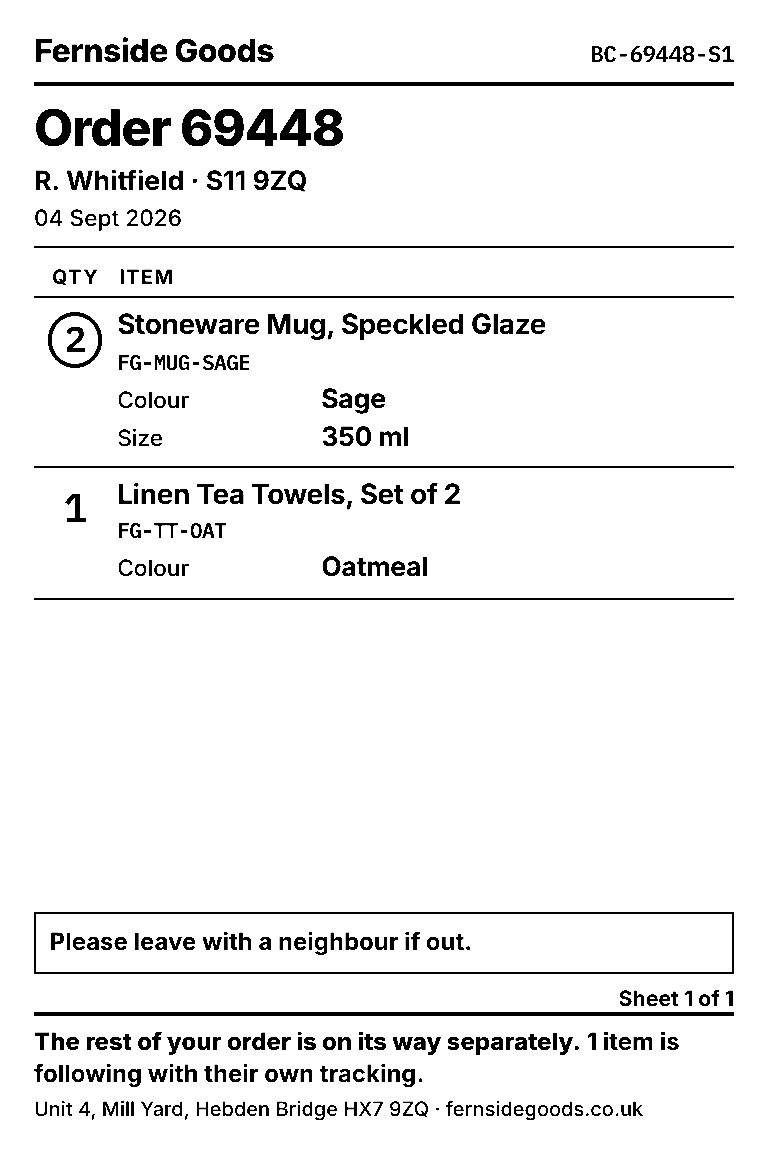
Every sheet below is the real thing, rendered by DispatchThread at six by four inches for a thermal printer, on demonstration orders. Nothing here is a mock-up drawn for a website.
A part shipment
Two lines in this box, the third left open, and a sentence at the foot telling the customer the rest is on its way with its own tracking. Quantities above one are circled so nobody packs one when the order says two.
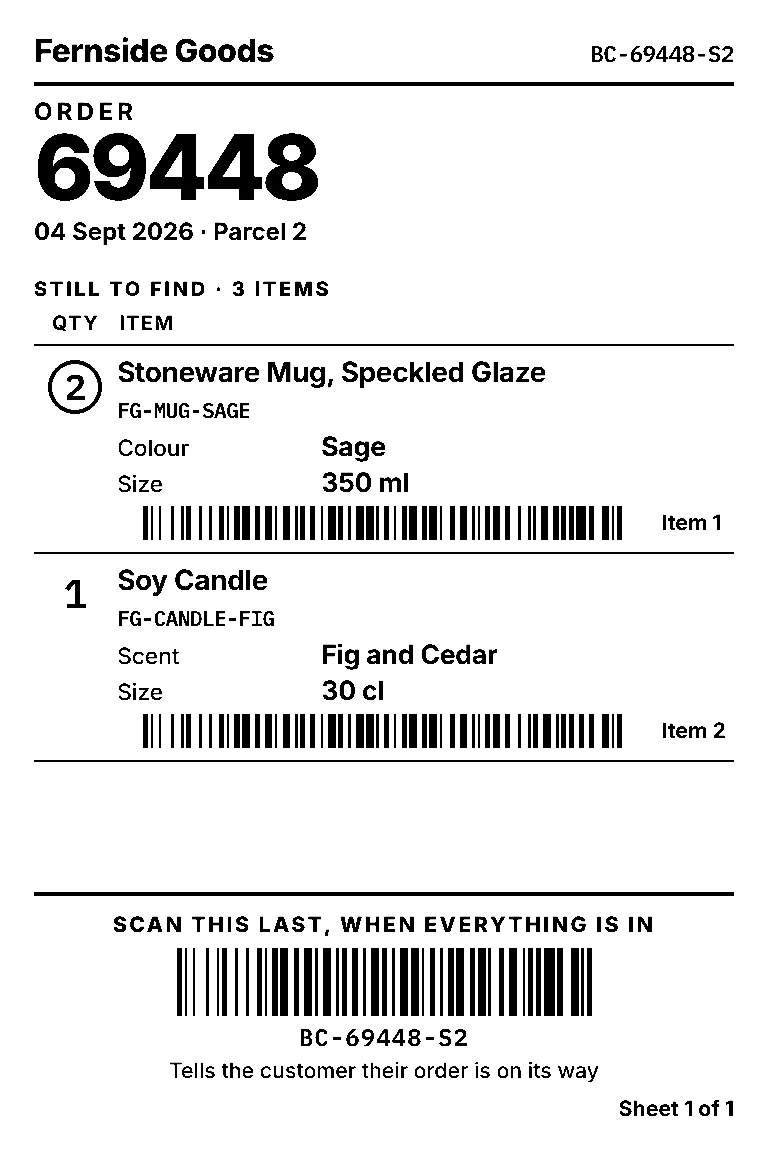
Waiting for a scan
The picker's sheet: what is still to find, each with its own barcode, and one at the foot to scan last, when everything is in. Until then the shipment is not written and the customer is not emailed. That last barcode is the parcel, not the order, so it releases this box alone.
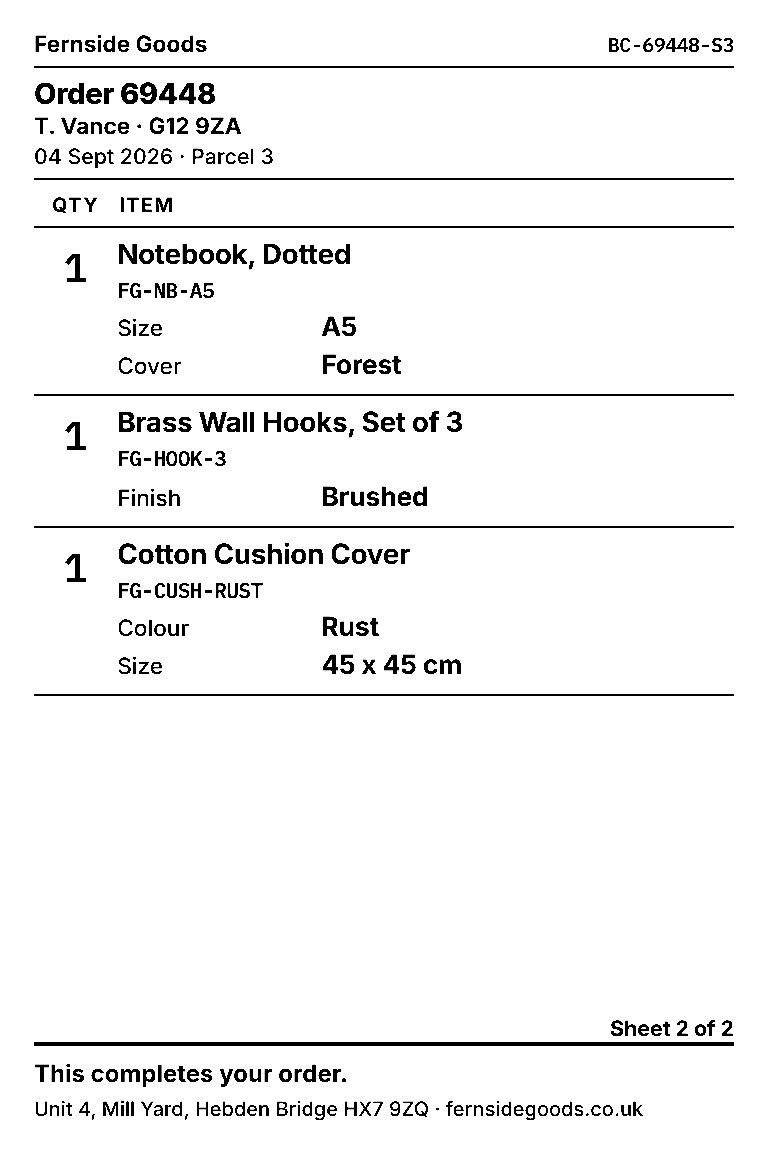
Sheet two
Seven items will not fit on one sheet, so it runs on. The second sheet drops to a half-size header, carries no second barcode, and says which sheet it is. They print in reverse so the pile comes off the printer the right way up.
The Royal Mail label is Royal Mail's. It arrives from your own account exactly as Click and Drop produces it, and DispatchThread prints it as sent without redrawing a single line of it. That is why there is no sample of one here: it is not ours to show, and a made-up one would tell you nothing true. What is ours is the paper above, and the fact that both sheets come out of the printer on the bench you are standing at.
Fifty orders a month, free
Free for fifty orders a month, with no card and no end date. Run it beside whatever you use now. It starts read only, so nothing is bought at Royal Mail until you turn it on.